

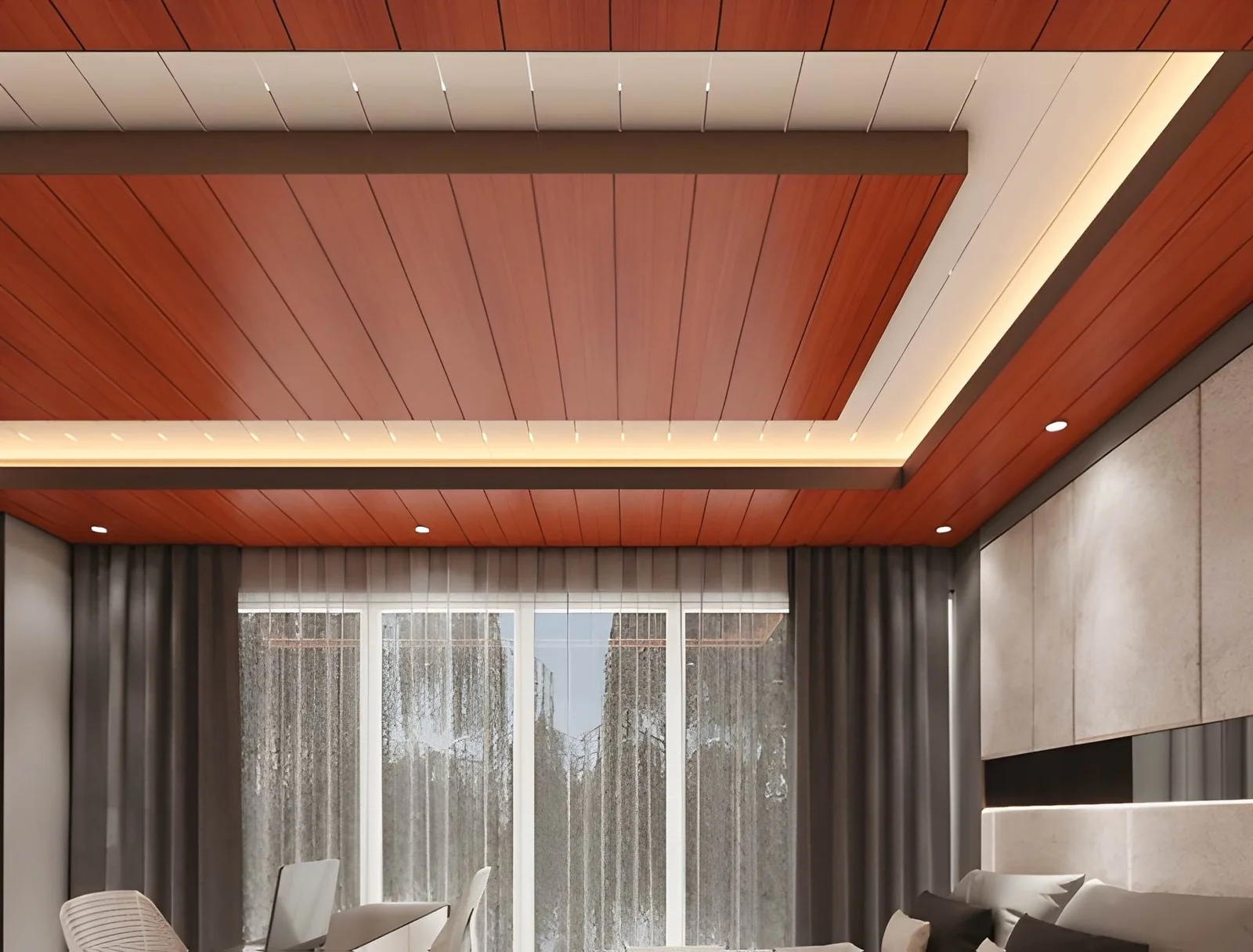
Every room has five surfaces. Four of them — the walls — get most of the design attention. Paint colors are deliberated. Artwork is selected. Trim is considered. The fifth surface, the one that covers more square footage than any single wall and is visible from every position in the room, typically receives a single decision made at construction: flat white.
The ceiling is the most consistently underdesigned surface in US residential interiors. Not because it’s unimportant — it’s arguably the surface with the most influence over how a room feels spatially and atmospherically — but because it exists outside the visual field most homeowners design within. You don’t look up when you’re planning a room. You look forward and around. The ceiling stays white by default while everything below it gets considered.
The result is rooms that are well-decorated in four directions and unaddressed in one — and that missing consideration shows. A room with a beautifully considered floor, furniture, and walls but a generic flat white ceiling is a room with an unresolved design. Something is always slightly off, and most homeowners can’t name what. This article names it: the ceiling, and what to actually do about it.
Why the Ceiling Matters More Than Most Homeowners Realize
The ceiling’s influence on a room goes beyond aesthetics. It determines acoustic behavior (how sound travels and reverberates), lighting distribution (where light comes from and how it reaches surfaces), perceived room height (which affects how comfortable the room feels to inhabit), and the emotional quality of the space — whether it feels sheltering, expansive, intimate, or unfinished.
| What the Ceiling Controls | How Default White Ceiling Handles It | What a Considered Ceiling Does |
|---|---|---|
| Room height perception | Neutral — no vertical cue | Enhanced or reduced deliberately based on desired feel |
| Acoustic behavior | Flat — maximum sound reflection | Texture or material absorbs sound differently |
| Light distribution | Reflects all light uniformly | Selective reflection creates zones and warmth |
| Room completion feeling | Absent — ceiling doesn’t contribute | Present — ceiling participates in design |
| Architectural character | Generic — same as every other room | Distinctive — room has identifying quality |
| Emotional atmosphere | Neutral — no particular feeling | Specific — warm, dramatic, intimate, expansive |
The acoustic point deserves specific attention. A flat plaster or drywall ceiling at standard US residential height reflects sound actively — contributing to the echoey, hard quality that makes some rooms feel cold and acoustically uncomfortable. Textured ceiling surfaces, wood planks, acoustic tiles in designed settings, and exposed beam structures all affect how sound moves through a room in ways that the visual appearance of the ceiling doesn’t predict.
The Ceiling Decisions That Actually Change Rooms
The Color Decision: Almost Always Underestimated
The assumption embedded in most US homes is that ceilings should be white — specifically a bright, reflective white that bounces light throughout the room. This is reasonable as a default. It’s limiting as an absolute.
A ceiling painted in a considered color rather than default white produces one of the most dramatic room changes available at the lowest possible cost. The specific effect depends on what color is chosen and how it relates to the walls:
Ceiling darker than walls: The ceiling lowers visually and creates a canopy effect — intimate, enveloping, and particularly effective in bedrooms and dining rooms where enclosure is psychologically appropriate.
Ceiling lighter than walls: The ceiling recedes and rises — making the room feel taller and more expansive. Particularly useful in rooms with lower ceilings that need to feel more generous.
Ceiling same color as walls: The most dramatic option — the room becomes a volume rather than a box. The visual boundary between wall and ceiling disappears, which produces a bold, architectural effect that reads as highly considered.
| Ceiling Color Relationship | Perceived Height Effect | Atmosphere Created | Best Room |
|---|---|---|---|
| Bright white (default) | Neutral | No specific character | Any room, no particular enhancement |
| Slightly off-white / warm white | Marginally warmer | More residential than default | Any room as a subtle upgrade |
| Same as walls | Envelope effect — neutral | Sculptural, dramatic, bold | Powder rooms, hallways, dining |
| Darker than walls | Lower perceived height | Intimate, cozy, enveloping | Bedrooms, dining rooms, studies |
| Lighter than walls | Higher perceived height | Airy, expansive, open | Living rooms, rooms with low ceilings |
| Contrasting accent color | Draws attention upward | Unexpected, design-forward | Feature rooms, bold spaces |
The Texture Decision: What the Ceiling Is Made Of
Beyond color, the ceiling’s material affects how the room reads and feels in ways that paint changes can’t fully address. The options available to US homeowners range from paint-only changes to material additions:
Wood plank ceilings introduce warmth, texture, and organic character that no painted surface replicates. White-washed or natural tongue-and-groove planks applied to a ceiling add the material quality that distinguishes designed spaces from painted ones. Installation cost: $3 to $12 per square foot depending on material and labor.
Tin ceilings (or tin-look stamped metal panels) introduce historical character and pattern that transforms the ceiling into a decorative feature. Particularly effective in kitchens, dining rooms, and spaces where historical character is appropriate. Installation cost: $3 to $8 per square foot.
Wallpaper on the ceiling is one of the most dramatically effective ceiling treatments available — producing results that are impossible to achieve with paint alone. A botanical pattern, a geometric design, or a textured grasscloth applied to the ceiling creates an immediate focal point that transforms the room’s character. The fifth wall, treated as an opportunity rather than a surface to finish, becomes the room’s most distinctive element.
The Structural Decision: What’s Added to the Ceiling
Beyond surface treatment, additions to the ceiling plane itself change how the room reads architecturally:
Ceiling medallions at light fixtures cost $20 to $80 and add the architectural detail that distinguishes the light fixture as a deliberate feature rather than a functional installation.
Crown molding at the ceiling-wall junction adds definition to where ceiling meets wall — a detail that most pre-1980s US homes had and that most contemporary homes lack, and whose absence is felt as a subtle incompleteness even by people who couldn’t name what’s missing.
Tray ceilings — a recessed central section framed by a step at the perimeter — add the dimensional quality that makes a room feel like it has architectural intention rather than simply a finished top surface.
What Happens to a Room When the Ceiling Finally Gets Addressed
The change that happens when a ceiling receives considered design treatment is difficult to predict for homeowners who haven’t experienced it — because it affects the room in multiple ways simultaneously.
Rooms with addressed ceilings feel more complete in a way that’s immediately perceived but often not immediately explained. Visitors to a room with a considered ceiling don’t always say “I love what you did with the ceiling” — they say “this room feels amazing” or “this space feels so special” without being able to identify why. The ceiling’s contribution operates above the level of conscious interior design observation for most people, which means its presence improves the room’s reception without being explicitly credited.
| Room Before Ceiling Treatment | Room After Ceiling Treatment |
|---|---|
| Four well-designed surfaces | Five considered surfaces |
| Furniture and walls doing all the work | Architecture supporting every element |
| Generic quality despite good choices | Distinctive quality that distinguishes it |
| Acoustic flatness | Changed sound behavior (if textured) |
| Light from one undifferentiated plane | Light modulated by ceiling’s color and material |
| Visitors notice individual elements | Visitors experience the room as a whole |
Frequently Asked Questions
Why is the ceiling so often overlooked in home design?
Because it exists outside the natural visual field when designing a room — most people look forward and around when assessing a space, not up. The ceiling is also the last surface applied during construction, often rushed, and set to a standard specification that becomes the default. Breaking this default requires actively deciding to address the ceiling rather than accepting the construction standard.
What’s the easiest ceiling change that makes the most difference?
Warm-white paint in place of bright white. This change costs the same as any ceiling paint, takes the same time to apply, and immediately makes the ceiling feel more intentional and the room below it feel warmer and more residential. It’s the smallest possible departure from default that produces a visible improvement — and it’s the starting point that makes every other ceiling decision easier.
Does painting a ceiling a dark color make a room feel smaller?
It reduces perceived height — which, depending on the room’s function and the homeowner’s intention, is either a positive effect (creating intimacy in a bedroom or dining room) or something to avoid (in a room where openness is the goal). The question isn’t whether a dark ceiling makes the room smaller — it’s whether the smaller feeling it creates is the right feeling for that particular room. For most bedrooms and intimate dining spaces, the answer is yes.
Is ceiling wallpaper practical?
Yes — with appropriate installation technique. Paste-the-wall (rather than paste-the-paper) method is recommended for ceiling application, as it’s lighter to handle before pressing to the surface. A helper is essentially required for ceiling wallpaper application. The result is a ceiling treatment that no paint technique can replicate — and that consistently transforms the room’s character more dramatically than any same-budget wall treatment.
What should I address first — walls or ceiling?
Ceiling first, always. Paint applied to walls after the ceiling is painted will be affected by ceiling overspray and drips. Beyond practical sequencing, the ceiling color and treatment should inform wall decisions — particularly if you’re using a tonal relationship (ceiling lighter or darker than walls) that requires the ceiling to be established first. Designing the ceiling as a first decision rather than an afterthought also changes how the whole room is conceived.
The Bottom Line
The ceiling is the missing part of most US home designs — not by necessity but by default. It received a builder’s standard decision and has been left there while every other surface in the room was reconsidered, updated, and improved.
Addressing it doesn’t require significant investment. It requires a decision — the decision to treat the fifth surface as a design surface rather than a finishing specification. Warm-white paint in place of bright white. A considered color relationship between ceiling and walls. A texture addition that gives the ceiling material presence. A structural detail that makes the ceiling-wall junction deliberate.
Any of these, applied to the ceiling that’s been white and ignored, changes how the room feels — in ways that visitors experience immediately even when they can’t name what changed.
For ceiling design ideas must visit https://thehometrottersblog.com/