

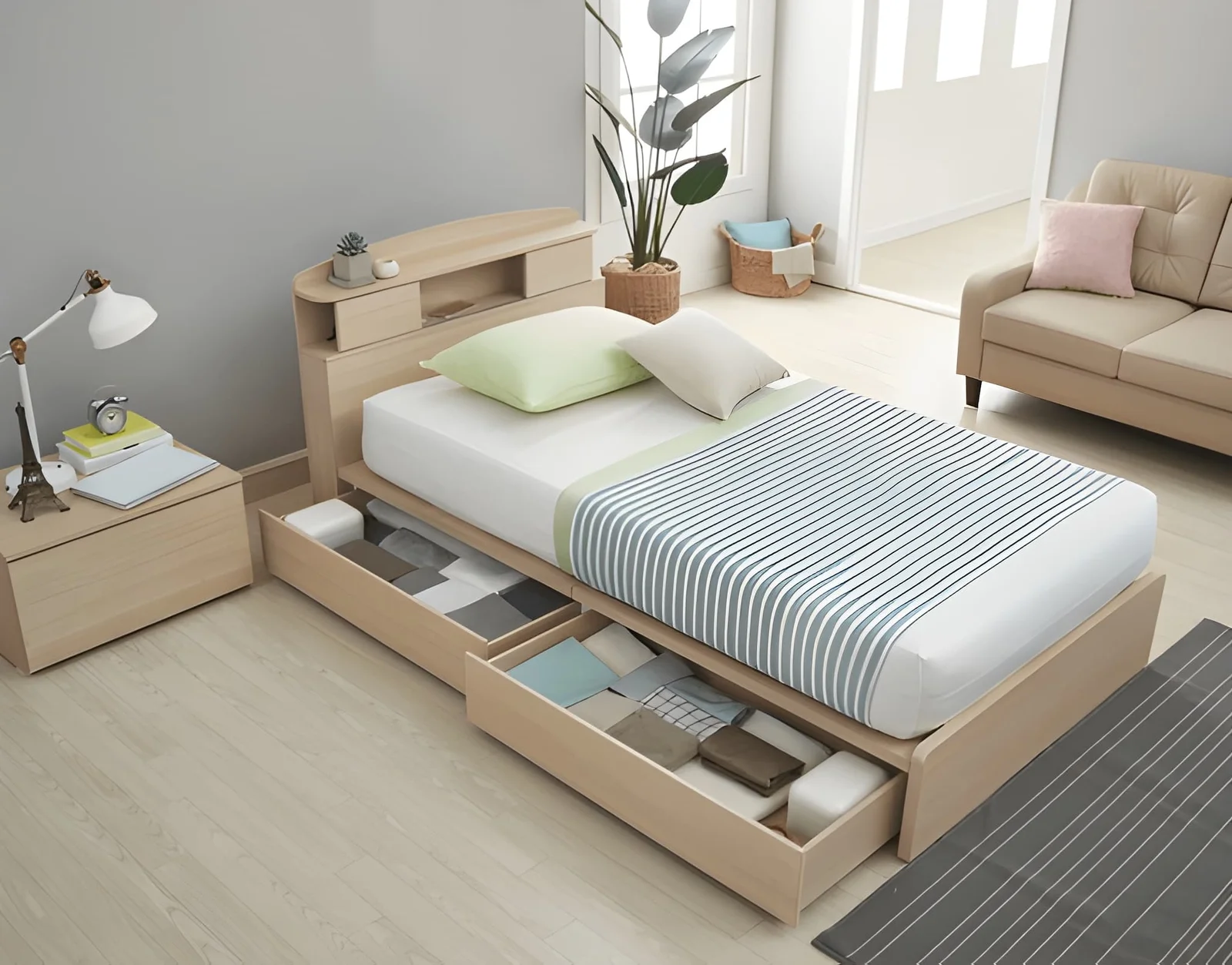
Most US homes have a hidden storage resource that goes almost entirely unused. It’s not a closet that needs better organization or a garage that needs a shelving system. It’s the space that already exists under your furniture — under the bed, under the sofa, under sideboards and console tables — that sits empty or accumulates dust while homeowners pay for additional storage solutions they didn’t need to buy.
The average US queen bed has roughly 20 to 30 cubic feet of storage space beneath it. The average sofa has 4 to 8 cubic feet. A console table, a sideboard, or even a well-positioned bench can provide additional hidden or semi-hidden storage at zero additional floor cost. This is space that’s already been allocated in the room’s footprint — space you’re already paying for in mortgage or rent terms — that most households aren’t using at all.
Why doesn’t it get used? Partly access — things stored under furniture can feel difficult to retrieve. Partly aesthetics — visible clutter under furniture is worse than no storage at all. And partly awareness — most homeowners simply haven’t thought about it systematically. This article covers all three: which spaces under your furniture are worth using, what to store in them, and how to do it in a way that looks organized rather than chaotic.
Why the Space Under Your Furniture Is Worth Taking Seriously
The storage math on under-furniture space is compelling enough to warrant attention even in homes that feel adequately organized. When every surface-level and closet storage option is already used, the space under your furniture represents the last large, untapped storage capacity in most US homes.
| Furniture Piece | Average Clearance Height | Approximate Storage Volume | Annual Use Potential |
|---|---|---|---|
| Queen bed (platform) | 7–12 inches | 20–30 cubic feet | High — daily accessibility |
| King bed (standard frame) | 12–16 inches | 30–40 cubic feet | High — largest residential under-storage |
| Standard sofa | 4–8 inches | 4–8 cubic feet | Medium — limited height, wide footprint |
| Console table | 24–30 inches | 15–25 cubic feet (open) | Very High — fully accessible |
| Sideboard | 4–6 inches | 3–5 cubic feet | Low — limited to flat items |
| Bench with open base | 12–18 inches | 8–15 cubic feet | High — designed for this use |
| Armchair | 4–8 inches | 2–4 cubic feet | Low — awkward access |
The bed is consistently the highest-value under-furniture storage opportunity in US homes — large volume, accessible from multiple sides, and in a room where storage is often in highest demand (clothing, seasonal items, bedding).
What to Store Under Your Furniture by Category
Under the Bed: The Highest-Capacity Under-Furniture Space
The space under your furniture in the bedroom is where most storage effort should concentrate first — because it’s the largest available volume and because bedrooms typically have the highest storage demand relative to available closet space.
What works best under beds:
Seasonal clothing and bedding. Items used quarterly rather than daily are ideal under-bed candidates. Winter sweaters in summer, summer linens in winter, extra blankets and duvet inserts not currently on the bed. These items need to be accessible but not daily, which matches the slight effort of under-bed retrieval.
Shoes not in current rotation. The 20 pairs of shoes not being worn this season store efficiently in flat under-bed shoe boxes or rolling shoe organizers. Shoes are flat, stackable, and don’t require opening containers to identify — exactly the profile of items that work well under beds.
Gift wrap and wrapping supplies. Flat, rarely accessed, and too large for most closet shelves — gift wrap rolls, tissue paper, and ribbon fit under beds in flat storage containers better than almost anywhere else.
| Item Category | Storage Container | Access Frequency | Why It Works Under Bed |
|---|---|---|---|
| Seasonal clothing | Vacuum storage bags or lidded bins | Quarterly | Flat profile, large volume |
| Seasonal bedding | Breathable fabric bags | Quarterly | Compresses well, needs air circulation |
| Shoes (off-season) | Shoe boxes or clear organizers | Seasonal | Flat profile, easily organized |
| Gift wrapping supplies | Flat wrap organizer | Monthly or less | Exactly the right flat profile |
| Books and magazines | Flat-lidded bins | Occasional | Heavy but low-profile |
| Sports equipment (flat) | Canvas bags or bins | Seasonal | Awkward in closets, fits under bed |
Under the Sofa: Limited but Useful
The space under your furniture in the living room — specifically under the sofa — has lower clearance than under beds but covers a significantly larger floor area. Most sofas have 4 to 8 inches of clearance, which limits what can be stored there but doesn’t eliminate utility.
What actually fits under most US sofas:
Flat items in thin containers: children’s puzzles and board games in their original boxes, magazines collected for later reading, wrapping paper in flat rolls, yoga mats stored in their original bags. The key constraint is the 4 to 8-inch clearance — anything taller than 6 inches won’t fit under most standard sofas.
Under-sofa storage also has an aesthetic dimension that under-bed storage doesn’t: the base of a sofa is visible from seated and standing positions throughout the room. This means visible under-sofa storage requires a more deliberate aesthetic approach than under-bed storage, which is largely hidden.
The aesthetic solution: a consistent set of baskets or boxes in the same material and color, positioned to look like a deliberate choice rather than random items pushed under a sofa. Low-profile woven baskets in a single neutral color, pulled out to sit just inside the sofa’s front edge, look styled rather than cluttered.
Under Console Tables and Sideboards: Open Storage Opportunity
The most underutilized under-furniture storage in most US homes is the open space under console tables, sideboards, and entryway benches — because this space is visible and therefore requires a more design-conscious approach but offers full-height access that under-bed and under-sofa spaces don’t.
Baskets under a console table are the classic solution — and the classic solution works because it provides significant accessible storage while reading as intentional decoration rather than storage overflow. Three matching baskets under an entryway console hold shoes, dog walking supplies, seasonal accessories, and reusable bags while the baskets themselves look like a deliberate design choice.
Making Under-Furniture Storage Look Organized, Not Cluttered
The difference between under-furniture storage that looks organized and under-furniture storage that looks like avoidance is primarily container consistency and visibility management.
| Storage Approach | Visual Result | Appropriate For |
|---|---|---|
| Mismatched boxes and bags | Cluttered — worse than empty | Nothing — avoid entirely |
| Consistent low-profile bins (same color) | Organized — looks deliberate | Under beds, under sofas |
| Matching baskets | Designed — reads as decor | Under consoles, benches |
| Vacuum bags (hidden by bed skirt) | Invisible — no aesthetic impact | Under bed with bed skirt |
| Clear rolling drawers | Organized — highly functional | Under beds with adequate clearance |
| Labeled lidded boxes | Functional — easy to find items | Under bed, not under sofa |
The bed skirt deserves specific mention for US homeowners who find under-bed storage organizationally valuable but aesthetically problematic. A bed skirt — a fabric panel that runs from the mattress to the floor, covering the bed’s entire base — hides everything under the bed completely while adding a finishing detail to the bed’s appearance. Under a bed skirt, the storage doesn’t need to be aesthetically considered at all because it’s entirely invisible.
Selecting Furniture That Maximizes Under-Furniture Storage
For US homeowners in the market for new bedroom or living room furniture, the clearance height under a piece is worth treating as a primary selection criterion rather than an afterthought.
| Furniture Type | Storage-Optimized Choice | What to Look For |
|---|---|---|
| Bed frame | Frame with 12″+ clearance and no center support | Minimum 12″ height, central gap for rolling storage |
| Sofa | Legs rather than skirted base | Any clearance is better than skirted — skirted has zero |
| Console table | 28–32″ height with open base | Standard desk height provides maximum storage |
| TV stand | Raised legs rather than cabinet-to-floor | Any clearance allows use of floor area |
| Bench | Open base rather than solid sides | Open base provides full access to stored items |
The skirted sofa and the platform-to-floor bed frame are the two furniture choices that eliminate under-furniture storage entirely. Both are common in US retail. Neither is wrong — but choosing them forfeits a significant storage resource, which is worth knowing before purchase.
Frequently Asked Questions
Is it worth using the space under your furniture for storage?
Yes — particularly under beds, where the volume is significant and the access is manageable. The space under your furniture is already allocated in your home’s footprint; not using it means relying on other storage solutions that consume additional floor space, wall space, or closet capacity. For most US homes, under-bed storage alone eliminates one or two additional storage pieces that would otherwise be needed.
What’s the best container for under-bed storage?
For visible under-bed storage (no bed skirt): consistent low-profile bins in the same color, ideally with lids and wheels for easy access. Clear-sided containers allow contents identification without opening. For hidden under-bed storage (with bed skirt): vacuum compression bags for textiles produce maximum volume efficiency; standard lidded bins for everything else. Label everything when using opaque containers.
How do I keep under-bed storage organized over time?
Categorize at the container level rather than the item level. One container for seasonal bedding, one for seasonal clothing, one for shoes — categories that rarely mix. Review and reorganize twice yearly when seasonal items rotate in and out. The biggest organization failure in under-bed storage is mixing categories in a single container, which requires unpacking to find anything.
Can I use the space under a sofa effectively if the clearance is only 4 inches?
4-inch clearance accommodates flat items: thin board games, magazines in a flat stack, wrapping paper rolls, yoga mats, and slim document folders. Use consistent low-profile containers (thin plastic trays or flat canvas bags) rather than standard storage boxes. At 4 inches, the storage value is limited but real — particularly for flat items that have no better alternative storage location.
Does storing items under furniture attract pests?
Only when items are stored without proper containers and when the space isn’t cleaned regularly. Sealed bins and vacuum storage bags eliminate the pest risk that open storage creates. Cleaning under furniture during regular vacuuming sessions — which under-bed storage makes necessary rather than optional — actually reduces pest risk compared to the unmonitored, uncleaned under-furniture space that most households currently have.
The Bottom Line
The space under your furniture is the most consistently overlooked storage resource in most US homes — already allocated in the room’s footprint, requiring no additional floor space, and available for immediate use with the right containers and organizational approach.
Under the bed for seasonal items, shoes, and gifts. Under console tables for everyday-accessible baskets. Under the sofa for flat items in consistent containers. Each of these uses existing space more efficiently than any additional storage furniture purchased to supplement inadequate existing capacity.
Before buying a new dresser, a storage ottoman, or an additional shelving unit, look under what you already have. The space is probably there. It’s been waiting.
Must visit https://thehometrottersblog.com/ for useful storage ideas.