

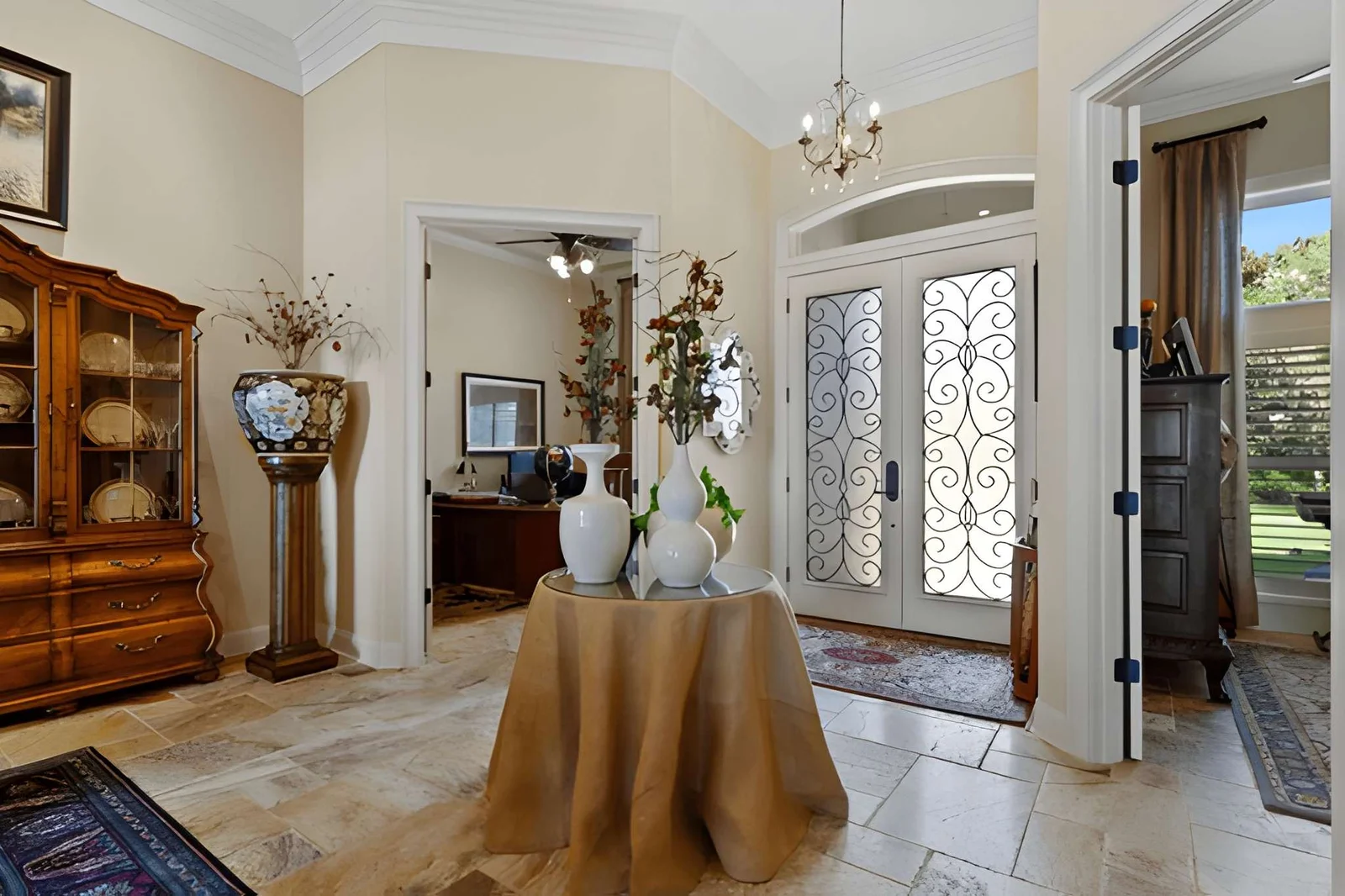
The front door closes and everything that came in with you — bags, coats, shoes, mail, keys, whatever was in your hands — needs somewhere to go. If the entryway has a system for those things, they go there. If it doesn’t, they end up on the nearest available surface: the kitchen counter, the hallway floor, the dining table, the couch. Not because anyone decided that’s where they belong but because the point of entry didn’t offer a better option.
This is how an inadequate entryway creates clutter throughout the rest of the house. The mess visible in the kitchen isn’t really a kitchen problem. The pile on the dining table isn’t a dining room problem. It’s an entryway problem — a failure at the point of arrival to capture items before they migrate to places where they become persistent clutter that’s harder to resolve.
Most US homeowners don’t think of the entryway as a clutter management system. They think of it as a small transitional space that needs a rug and a mirror. This article explains why it’s the most strategically important organizational space in the home — and what specifically needs to change to make it work.
Why the Entryway Determines Clutter Levels Throughout Your Home
The entryway is the first decision point of every household member’s return — the moment when items either find a designated home or begin migrating. Items that don’t find a home at the entry point don’t stop moving until they reach a surface that’s available, which is usually the nearest flat surface in the most-used room.
| Item That Enters Home | Without Entryway System | With Entryway System |
|---|---|---|
| Keys | Kitchen counter, various surfaces | Designated hook — always found |
| Bags and backpacks | Floor of living room, dining chairs | Hook or dedicated shelf at entry |
| Shoes | Hallway floor, random rooms | Shoe storage at door |
| Kitchen counter, dining table | Mail tray or sorting station at entry | |
| Coats | Couch, bedroom chair | Hook at entry |
| Reusable shopping bags | Multiple rooms | Hook near door |
| Sports equipment | Wherever it lands | Bin or rack at entry |
The pattern is consistent: items without an entry system migrate to the home’s most-used surfaces and become the clutter that US homeowners spend minutes each day managing, moving, and searching through. The entryway system doesn’t add organization to the home — it prevents disorganization from spreading in the first place.
What an Effective Entryway Actually Needs
The Hook System: Non-Negotiable
Hooks are the single most impactful entryway addition available — because hanging items is the fastest action available at the point of entry. A hook requires one hand and one second. A coat closet requires opening a door, finding a hanger, placing the coat, and closing the door — four steps that most household members skip under time pressure, which is why the coat ends up on the nearest chair.
A row of hooks at the entryway — one per regular household member, plus one or two for guests — eliminates the coat-on-chair problem permanently. Everything that hangs goes on the hook: coats, bags, reusable grocery bags, dog leashes, umbrellas. The hook captures these items at the exact moment they would otherwise begin migrating.
Hook placement height matters: the primary row at 60 to 66 inches for adult coats and bags, with a second lower row at 36 to 42 inches if children or short items are part of the household’s daily pattern.
| Hook Configuration | Items Captured | Space Required | Cost |
|---|---|---|---|
| Single coat hook | Coat only | 3″ wide | $5–$20 |
| Row of 4–6 hooks | Coats, bags, umbrella, leash | 18–30″ wide | $20–$60 |
| Wall-mounted rack with hooks + shelf | All hanging items + keys + small items | 24–36″ wide | $40–$120 |
| Full entryway station (hooks + bench + storage) | Everything | 36–60″ wide | $80–$400 |
Shoe Storage: The Second Priority
Shoes removed at the door — the practice that keeps floors clean and extends flooring life — pile up immediately without a designated storage system. A shoe pile by the door is one of the most consistent sources of entryway clutter in US homes, and it extends into the entryway proper because there’s nowhere better to put them.
A shoe rack, bench with shoe compartments, or open cubby shelf at the entryway accommodates two to four pairs per household member in active rotation. Not the entire shoe collection — just the shoes that get worn regularly. Seasonal and special-occasion footwear belongs in bedroom storage; the entryway system is for the five pairs each person reaches for weekly.
A Mail and Paper Station
Paper is the item most consistently mismanaged at the entryway — mail gets brought in, set on the nearest surface, and stays there until it migrates to a pile. Without a specific landing point at the entry, paper immediately becomes the kitchen counter’s problem.
A wall-mounted mail sorter, a small tray on an entryway console, or a designated basket captures incoming paper at the point of arrival before it begins migrating. This doesn’t solve the paper management problem completely — that requires a periodic sorting and processing routine — but it concentrates the paper into one location rather than letting it spread.
The Key Landing Zone
Keys are the single most searched-for item in US households. The average American spends 2.5 days per year looking for misplaced keys — almost entirely because the key landing zone isn’t at the entry where keys are removed from pockets and hands. A hook, a bowl, or a key rack within arm’s reach of the door reduces this to zero search time per key.
Entryway Problems by Home Type and Their Solutions
Different US home configurations create different entryway challenges. The solutions vary, but the principle is consistent: capture items at the point of entry or lose them to the rest of the home.
| Home Configuration | Entryway Challenge | Best Solution |
|---|---|---|
| Direct entry from street (no vestibule) | No transition space — items immediately in main room | Entry zone created with rug, console, and hooks |
| Apartment with door opening to living room | Entry and living room compete for space | Narrow console table + hooks on adjacent wall |
| Home with large foyer | Too much space — items spread out rather than organized | Defined zone with furniture grouping, not whole foyer |
| Garage entry (most US homes) | Garage door → mudroom/laundry → kitchen | Hook station and shoe rack at garage-interior door |
| Side door frequently used | Second entry unorganized, primary neglected | Duplicate hook and shoe system at both entry points |
| Shared building entry | Items must wait in apartment entry | Same system — hooks and shoe storage at apartment door |
The garage entry deserves special attention for US homeowners. In most American homes, the most-used entry point is the garage door to the interior — not the front door. An entryway system at the front door that’s ignored because 95% of entries happen through the garage isn’t solving the problem. The hook and landing systems should be at the entry point that’s actually used most.
The Design Side: Making the Entryway Look Good While Doing Its Job
An entryway that does its organizational job but looks chaotic has partially failed. The visual experience of the entryway sets the tone for every arrival into the home — both for household members returning and for guests arriving. A well-organized entryway that also looks considered produces a different first impression than one that’s functionally correct but aesthetically afterthought.
Design principles that make entryways look intentional:
Consistent material. Hooks, bench, and storage in the same material family — all wood, all metal, or a consistent combination — look designed rather than assembled.
Controlled color. Coats, bags, and shoes in multiple colors are unavoidable — but the organizational furniture itself in neutral tones keeps the visual result manageable.
One decorative element. A mirror (which also serves the functional purpose of checking appearance before leaving), a plant, or a piece of artwork gives the entryway visual interest that elevates it from purely functional to genuinely designed.
Frequently Asked Questions
Why does clutter always end up on my kitchen counter even though I try to keep it clear?
Almost certainly because the entryway isn’t capturing the items that would otherwise go to the kitchen. Keys, mail, bags, and daily-carry items need a landing point at the moment of entry — which is the door, not the kitchen. Without that landing point, items travel to the nearest available surface, which in most US home floor plans is the kitchen counter. The fix is at the door, not at the counter.
What’s the minimum an entryway needs to function effectively?
Three things: a hook for coats and bags, a shoe solution for footwear at the door, and a key landing point within arm’s reach of the lock. These three elements — which can be implemented for $30 to $80 total — capture the highest-volume daily items before they migrate. Everything else (mail station, full bench, console table) improves the system but isn’t essential for the basic clutter-prevention function.
How do I create an entryway when my door opens directly into the living room?
Define the zone rather than the room. A rug inside the door, a narrow console table (12 to 14 inches deep) positioned adjacent to the entry, and hooks on the wall beside the door create an entry zone that functions organizationally without requiring a separate physical space. The visual boundary of the rug and the functional purpose of the console and hooks produce the entryway effect even within a shared space.
How much space does a functional entryway need?
Much less than most homeowners assume. A 24-inch wide wall section for hooks, a 12-inch deep x 24-inch wide console table for mail and keys, and 18 inches of floor space for a shoe rack is a complete functional entryway. Total footprint: approximately 2 feet wide by 18 inches deep — less than most closet doors. In apartments and smaller US homes, this minimal configuration captures most daily items without consuming meaningful living space.
Should I have a closed coat closet or open hooks in my entryway?
For daily-use coats, open hooks consistently outperform closed closets for the household’s actual behavior. Hooks require one action (hang); closets require four (open, find hanger, hang, close). Under the time pressure of arriving home with bags and shoes to manage, most household members skip the closet and default to the nearest surface. Open hooks in the entryway eliminate this by being faster than the alternative. Reserve the closet for less-frequently accessed items; use hooks for daily coats and bags.
The Bottom Line
The entryway isn’t just the first room guests see — it’s the organizational system that determines whether daily items find designated homes or spread throughout the house as clutter that has to be managed repeatedly. An entryway that lacks hooks, shoe storage, and a key landing point isn’t just visually incomplete — it’s actively generating the clutter appearing on kitchen counters, dining tables, and living room chairs.
The fix is specific and inexpensive: hooks for daily hanging items, shoe storage at the door, and a key spot within arm’s reach of the lock. Three elements, $30 to $80, one afternoon to implement. The clutter that’s been appearing on every other surface in the home stops appearing there — not because habits changed but because the entry system is finally doing its job.
For more entryway ideas must visit https://thehometrottersblog.com/