

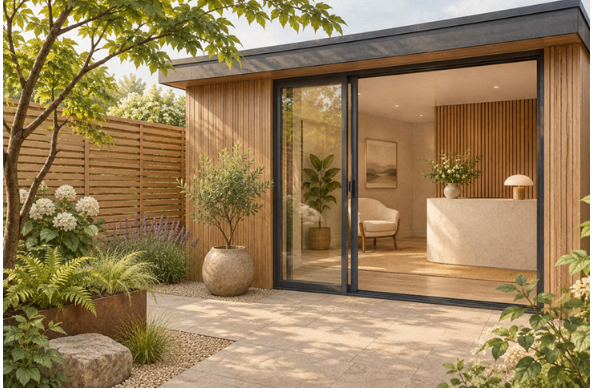
The appeal of a small garden office is often the distance it puts between your desk and the house. You can concentrate, make a call or leave work behind a separate door. But that sense of separation can disappear if the desk faces a busy path or every movement in the garden draws your attention.
Small garden office privacy is usually a matter of placement before it becomes a matter of barriers. A slightly different desk position, a clearer route or a screen in the right place may solve the problem without closing in the garden. Work out which views and activities bother you, then design around those specific moments.
Look at the office from both sides
Sit at the proposed desk and look towards the house, gate and neighbouring boundaries. Then walk those routes and look back. You may find that one narrow sightline exposes the screen while the rest of the room already feels private.
Repeat the exercise at different times. A bright interior can be more visible after dark, and planting that provides summer cover may look quite different in winter. Think about the hours you actually work rather than judging privacy only on a sunny weekend afternoon.
Write down the problem plainly. Perhaps people can read the monitor, or perhaps you simply find movement distracting. These are related but different needs. A solution that hides the screen may leave you watching the same busy route every time you look up from the keyboard.
Try another desk position
Before changing the boundary, move a temporary table around the room. Turning the desk can take a monitor out of a direct sightline and help the workspace feel calmer. It may also improve the light on the screen.
Check the arrangement during your normal working hours. Look for reflections, shadows and the point where you naturally want to place a lamp. Keep enough space behind the chair to move comfortably. A desk positioned for the best photograph can become frustrating when every cupboard opening requires you to stand up.
You can still enjoy the garden without facing the largest window. A view to one side may provide a pleasant pause while leaving the main work surface less exposed. Test the positions before committing to built-in furniture or fixed equipment locations.
Screen the view that needs attention
Once you understand the sightlines, decide whether the garden needs a defined boundary or a smaller intervention. A short return panel may provide privacy beside the office door, while another part of the garden can remain open.
NeoTimber’s fencing gives you a range to consider where a new boundary is appropriate. Compare finishes beside the office exterior and look at the full arrangement, including posts and any gate. Check ownership, applicable restrictions and the site’s conditions before specifying the installation.
Think about maintenance access along the boundary as well. Planting can soften the view, but it needs space to grow and somewhere to be reached. Avoid filling a narrow gap with shrubs simply to conceal it. A manageable edge will continue to look intentional as the garden develops.
Keep one clear route through the garden
A compact garden feels busier when its paths are interrupted by furniture or storage. Establish the route to the office and protect it from the things that tend to accumulate outdoors. A clear journey makes the workroom easier to use and helps the rest of the garden retain its own purpose.
If clients visit, consider their route separately from family activity. They should know which gate to use and where to pause, without walking across a private seating area. Test your arrival instructions with someone unfamiliar with the property.
Look at wet-weather use, too. A path that works well in summer may become the reason you avoid the office in winter. Address persistent surface or drainage problems through the appropriate design, rather than expecting footwear and a large mat to solve everything at the door.
Give appointments a comfortable place
If meetings are a regular part of the business, a defined arrangement is worth the space. Two suitable chairs or a small table may be enough. The visitor needs somewhere to sit and place a bag without occupying the main desk or blocking the doorway.
Keep confidential paperwork out of that area and organise the items used during appointments. A cramped room can still feel professional when the conversation has a clear place. It becomes awkward when the owner has to move a printer, clear a chair and find a surface for notes every time someone arrives.
Where project examples or changing visitor information need a dedicated screen, Teksmart’s digital signage is one option to investigate. Decide what the display will explain before choosing it. Check the viewing distance and location, use content you have permission to show and keep private customer information away from a public-facing screen.
Remember that quiet is a separate question
A screen or fence can change a view without providing the sound control you need. If sensitive calls are part of the work, consider the building’s construction and how sound travels through doors, windows and ventilation. Seek advice suited to that particular concern.
Inside, the position of the meeting area and the use of furnishings affect how the room feels during a conversation. Avoid assuming that a few decorative additions will soundproof a lightweight garden building. Make decisions based on the actual use and performance required.
Temperature and daylight matter to concentration as well. Review shading, ventilation and heating before filling the room. A private office that feels uncomfortable for several months of the year is unlikely to provide the working routine you hoped for.
About NeoTimber
NeoTimber supplies fencing alongside decking, cladding, balustrades and outdoor furniture. Its fencing resources include samples, calculators and installation information that can help you compare a proposed boundary before choosing the final system.
For a small office garden, start with the view you want to screen and use the product information to discuss a suitable layout with the installer. The aim is a boundary that works with the room and the remaining garden. Reviewing the gate, posts and finish together helps you avoid making an isolated panel choice that becomes awkward when the whole run is planned.
Leave some garden for the rest of the day
Preserve a place to sit where you aren’t looking directly at the desk. Give ordinary garden storage a home, too, so the office route doesn’t become the only available place for outdoor belongings. Those small separations help work and home feel distinct without dividing every part of the plot.
After a few weeks, review what still feels awkward. Notice when privacy is lacking and whether the meeting arrangement gets used as expected. Move a chair or adjust the screen before committing to more construction. A well-planned small garden office should let you focus during the day and step back into an enjoyable garden when the work is done.Read more at https://thehometrottersblog.com/.
 Trisha